Bone Health · In Depth
Bone Health Specialist: “The Calcium Was Never the Problem. Nobody Ever Told It Where to Go.”
If you have taken your calcium exactly as prescribed and your last scan still moved the wrong way, or you have already broken something doing nothing at all, this is not a discipline problem. It is a delivery problem nobody explained to you.

Editor's note: this batch of Goatly is moving faster than the farm expected. Check availability before you read on.

Let me start with what a nurse may already have told you, off the record, in a corridor rather than a consultation room: that the calcium in your tablet does not simply disappear if your body cannot use it. It has to go somewhere.
She is right to be uneasy about that. I am going to show you exactly where it goes, and more importantly, what actually gets it to the one place you want it: your bone.
Twenty-two years in this job, and for most of them I told women the same thing. Take your calcium, every day, without fail, and your job is done.
Then I started asking a different question. Not whether she had taken it, but once she had swallowed it, then what.
That question changed how I practise. It is the reason some of my patients' follow-up scans are now coming back with smaller drops, sometimes no drop at all, instead of the slow slide they had come to expect. Not because they tried harder. Because the calcium finally had somewhere to go.
This has nothing to do with the form of your tablet, whether it is a pill or a powder. It has to do with something almost nobody explains: calcium on its own has no destination built into it. It needs a team to carry it there. Miss that team, and it makes no difference how faithfully you take it.
[STAT-SLOT: cijfer over hoeveel postmenopauzale vrouwen in het VK osteopenie of osteoporose hebben, om hier de schaal te zetten voordat Frances' individuele verhaal begint]
The Life Frances Quietly Rebuilt Around Her Own Body
The women in this article are real patients of mine. Names and identifying details have been changed throughout. Nothing about what happened to them has.
Let me show you what the mechanism I just described actually costs a real woman to live without, because it means very little until you see it in one life, in detail.
Frances is 64.
I want to start with the jar.
Every Sunday for as long as she can remember, Frances has made a pot of tea and put out marmalade for her husband's toast. Two years ago, without ever deciding to, she started running the lid under the hot tap before she tried to open it. Then she started leaving it slightly loose after the first opening, so she would never again have to break the seal from cold. She never mentioned this to anyone. It was a small adjustment, made so quietly that she had almost convinced herself it never happened.
Then came the bra.
Frances used to fasten hers behind her back without a thought, the way she had done since she was a teenager. Somewhere in the last eighteen months, that stopped being possible without a sharp pull in her shoulder and wrist. Now she does it up at the front, low around her waist, and turns it round the right way after. It takes four seconds longer. She does this twice a day, every day, and has never once said it out loud to her GP, because how do you raise something so small.

Frances has kept a rose bed in the back garden for eleven years, since she retired from the school office where she worked for two decades. Deadheading and pruning used to take her twenty minutes on a Saturday morning, down on both knees in the soil. Last summer she had her son-in-law build her a raised bed, waist height, so she could tend it standing. She told her daughter it was for her knees. It was for her knees. It was also so nobody would see how long it now took her to get back up off the ground, and how she had started planning, before kneeling, exactly what she would hold onto to stand again.
These are not the moments that make it into a diagnosis. They are the moments that make up a life.
Her grandson Ollie is four. Until last spring, Frances lifted him onto the kitchen counter to help her make biscuits, hooked her hands under his arms and swung him up the way she had swung his own mother up thirty years before. Then, one Tuesday, she felt something give in her lower back mid-lift and had to set him down faster than she meant to, laughing it off so he would not notice. She has not lifted him since. She waits for her husband, or her daughter Emma, and says "ask granddad" in a voice that sounds, to her own ears, exactly like her mother's voice sounded when her mother could no longer do it either.
There is a doorframe in Frances's kitchen where three generations have marked their height in pencil. Her mother started it. Frances added her own marks through her twenties and thirties, mostly as a joke with her own children. She has not stood against that doorframe in four years. She tells herself the pencil has gone missing. It has not gone missing. She is afraid of what the mark would say, and more afraid of who would have to explain it to her.
Her sleep changed too, in a way she only mentioned to me in passing, the way people mention things they have decided not to worry about. She wakes most nights around twenty past three, not from a dream, but from an ache low in her back when she turns over. She used to sleep through until her alarm. Now twenty past three is simply a fixture, like a chime she has learned to sleep through the second half of.
And then there is the letter.
Every eighteen months, a plain brown envelope arrives from the hospital with her scan results. Frances leaves it on the kitchen side, unopened, for at least a day. Sometimes two. Her husband has learned not to ask about it until she raises it herself. She told me once that she opens the gas bill the moment it lands, and lets the DEXA letter sit, because a gas bill can only ever tell her a number she can pay. The other envelope might tell her something she cannot fix by writing a cheque.
None of this looks like illness from across the room. Frances gardens most weekends, drives herself everywhere, remembers every birthday in the family before the rest of them do. If you passed her in the supermarket, you would see a woman managing perfectly well. What you would not see is the marmalade jar, or the four extra seconds at the small of her back, or the doorframe she walks past twice a day without looking at.
What changed for Frances was not one fracture, or one fall. It was the slow accumulation of small defeats, each one so minor on its own that she never thought to add them up. She took her calcium every single day. She did the walking her GP told her to do. She ate what she was told to eat. And somewhere over four years, without a single dramatic event, she became a woman who quietly reorganised her whole life around a body that no longer did what she asked of it without a small negotiation first.
She still has not opened the last letter.
Everything Frances Tried Before This. And Why None Of It Held.
By the time Frances came to see me, she was not a woman who had done nothing. She was a woman who had tried almost everything, in order, over the four years since her first scan came back at minus 2.9 and the word osteoporosis was said to her for the first time, and she had watched her scan move the wrong way regardless.

She started, like most women do, with the calcium tablet her GP prescribed: Adcal-D3, 1,200mg of calcium a day split across two doses, taken with food exactly as the leaflet said. Eighteen months in, her scan had not improved. Her GP's answer was a stronger dose. That did not move it either, and it would not have. The Royal Osteoporosis Society's own position, backed by Professor Tim Spector's review of thirty-three separate studies covering more than fifty thousand adults over fifty, is blunt on this point: there is no good evidence that calcium tablets alone reduce fracture risk. More of the same isolated rock was never going to succeed where the isolated rock itself had already failed.
Next came alendronic acid, the weekly tablet that works by slowing the natural breakdown of old bone rather than helping build new supply. It did what it is designed to do. It did not touch the thing that was actually wrong, and after eight months Frances stopped it herself, unsettled by heartburn she had never had before and a jaw ache she read too much about online at two in the morning. I want to be clear here, because it matters: if your GP has you on a bisphosphonate and it agrees with you, that is a decision between you and your doctor, not something this article is asking you to undo.
She bought magnesium and vitamin K2 separately, on the advice of a friend from her walking group, because she had already read the same thing you may believe yourself: that calcium needs an escort to reach the bone rather than the artery. She was right to believe that. Where the plan fell apart was in the delivery. Three more tablets to remember, three more amounts for her body to guess the ratio of, still no matrix holding them together the way food does. Buying the right ingredients separately is not the same as your body receiving them together, in the proportions they actually work in.
She tried eating her way there instead, the advice her GP gave in the same breath as "cut back on the tablets if you can": more yoghurt, more cheese, a glass of milk most evenings. Here is the part almost nobody says out loud. After fifty, absorption efficiency drops across the board, and research out of the University of Granada, comparing calcium carried in a dairy matrix against calcium from an isolated supplement, found the two behave very differently: roughly 25 to 35% absorption for calcium held in a dairy matrix, against a ceiling of only 20 to 25% for the isolated carbonate in a standard tablet. An extra wedge of cheddar at lunch is a perfectly good habit. Spread across an already-declining absorption rate, it was never going to close a gap that size.
She tried collagen, because everyone in her family had started taking it for their joints. It may have helped her skin. It was never built to solve a delivery problem in bone.
She looked, briefly, at AlgaeCal, the plant-based calcium sold widely online, close to a hundred pounds a pot. Different rock, same isolated mineral, still without the matrix that tells it where to go. She decided against it before she had even opened the box.
Then, at her most recent medication review, her GP did something that unsettled her more than any of it. Looking at her food diary, he told her she was probably getting enough calcium from her meals already, and took her off the tablet altogether, leaving only her vitamin D. Frances did not feel reassured. She felt abandoned halfway through a plan nobody had properly finished. Getting enough calcium on paper and getting calcium to your bone are two separate questions, and her GP, entirely reasonably, was only ever answering the first one.
And she exercised. Walking most days, a gentle strength class on Thursdays, exactly as every leaflet from the Royal Osteoporosis Society tells women to do. She should keep doing every bit of it. Exercise tells your bone it is still needed. It does not hand your bone the raw materials to answer that call.
Underneath all of it sat the option she never said out loud, the one every woman in her position quietly weighs: do nothing further, and hope the slide slows on its own. That is a choice too, and the scan does not treat it any more gently than the others.
By the time she sat in my clinic, Frances had tried the tablet, the stronger tablet, the bisphosphonate, the separate co-factors, more dairy, collagen, an AlgaeCal pot she never even opened, and every form of exercise recommended to her. Her scan, over those same four years, had gone from minus 2.9 to minus 3.2. Every one of these solves a different, real problem. Not one of them solves the one problem underneath all of it, which almost nobody had explained to her.
What Nurses Say Off The Record, And Your GP Has Ten Minutes To Explain
Here is the thing nurses on the wards have started saying to each other, quietly, that has not yet made it into a ten-minute GP appointment.

Calcium has no destination built into it. It is raw material, nothing more, and raw material has never once organised itself into a finished structure. Nobody pours bricks onto a plot of land and returns a year later to find a house standing. Somebody has to direct the delivery, place each load, mark out where the wall goes and where the door goes. Bone is built the same way. Calcium is the delivery. It is not the plan.
The plan is carried by a small team most tablets never mention. Phosphorus, in the ratio bone itself needs to form its mineral structure, binds alongside calcium to create the actual crystal; without it, calcium has nothing to lock onto. Magnesium acts as the foreman on site, required to activate the vitamin D that governs the whole build. And vitamin K2 is the signpost. It physically directs calcium toward bone tissue and away from soft tissue. Without that signpost, calcium does not vanish. It settles wherever it happens to end up, and the walls of your arteries are one of the places it can end up.
Where your calcium actually ends up
No signpost. It drifts, and some settles in the wall of an artery.
Phosphorus, magnesium and K2 carry it to the bone, where you want it.
This is not a fringe theory. A 2010 study published in the BMJ, tracking women taking calcium supplements above 500mg a day, found 27 to 31% more heart attacks in the supplemented group than in the group taking a placebo. Adcal-D3 alone carries 1,200mg of calcium a day at the standard dose, more than double that threshold. That is not a reason to fear calcium. It is a reason to fear calcium with nowhere to go.
There is a second half to this that almost nobody mentions, because it is less dramatic and equally important. After fifty, the gut itself absorbs less calcium from anything you give it, tablet or food, simply as a function of age. That is not a reason to give up on calcium. It is a reason to stop wasting the calcium you do take on a form that was never going to reach the destination anyway, at exactly the age when travelling had already become harder. Even taken with total discipline, only 20 to 25% of the calcium in a standard tablet is ever absorbed. The rest passes through unused.
Put the two together and the picture is uncomfortable but simple. A woman can take her tablet every single day for a decade, and if that tablet is isolated rock with no team, absorbed at only 20 to 25%, while her gut takes in less of it every year regardless, her bone was never going to see very much of it. Not because she failed. Because the calcium had no address to travel to.
It was never about how much calcium you took. It was about whether it had anywhere to go.
None of this sits still and waits for you to work it out. Bone lost in your fifties and sixties does not queue up politely for the day you finally fix the delivery problem. The longer calcium keeps arriving with nowhere to go, the more ground there is to make up later, and ground left long enough gets harder to recover, not impossible, just harder. That is not a reason to panic about a deadline nobody can honestly give you. It is a reason not to spend another year on a mechanism already proven not to work.
Once you accept that, something else becomes obvious. Every alternative Frances tried before this, the stronger tablet, the separate co-factors, the extra cheese, all of it, was aimed at the wrong variable. They were all trying to increase or rearrange the calcium. None of them solved the delivery problem underneath it, which means, in a strange way, none of them were ever going to work regardless of how faithfully she stuck to them.
If your calcium has never had anywhere to go, here is what Frances changed →
Why Goatly Is Built The Way It Is
This is why Goatly exists, and why the specification of it matters more than the marketing of it.

Whole goat milk already carries its own delivery team, the way whole food always does and an isolated mineral never can. The calcium sits inside a natural matrix alongside phosphorus, in the ratio bone itself needs, magnesium, and vitamin K2, plus a specific transport protein called casein phosphopeptide. Researchers at the University of Granada identified this protein's exact role: it binds calcium in the gut and carries it across the intestinal wall toward bone, rather than leaving it to drift into the bloodstream unescorted. The same Granada research is where the 25 to 35% absorption figure above comes from, measured against the 20 to 25% ceiling for isolated tablet calcium.
Goat milk is also exclusively A2 beta-casein, never the A1 beta-casein that modern high-yield Holstein cows produce through selective breeding, which has been linked to digestive discomfort in some adults after fifty. That matters if any part of the last four years of your life has involved dairy sitting heavily on your stomach.
Goatly takes that whole matrix and concentrates it seven times over by weight, simply by drying the milk down gently rather than diluting it with water the way a carton on a supermarket shelf already has been. This is the point most people misread, so I want to say it as plainly as I can. Concentrated does not mean more calcium crammed into the scoop. It means the whole matrix, the protein, the phosphorus, the magnesium and the K2, at seven times the strength of an ordinary glass of milk. One scoop carries roughly 400mg of calcium and around 14 grams of A2 protein, a modest, food-normal amount, well within what a single meal would give you. What changes is not the size of the dose. It is that this dose now travels with everything it needs to reach your bone instead of your bloodstream. No pill on any shelf can say that, because a pill is, by definition, one isolated thing on its own, and one isolated thing was never what your bone needed in the first place.
That distinction matters directly against the BMJ figures in the previous section. This is not a stronger dose of isolated mineral sitting above the 500mg threshold that study flagged, with no team accompanying it. It is a food-normal dose of the same mineral your body already receives from milk, delivered whole, with its team intact. If you have ever worried, reasonably, that a concentrated calcium product might be a concentrated risk to your arteries or your kidneys, this is the specific worry that matrix delivery is built to answer.
The drying itself is done at low temperature, deliberately slower and more expensive than the high-heat spray-drying used for most shelf-stable milk powders, because heat denatures the very proteins, the casein phosphopeptide and the A2 casein itself, that make the matrix work. A powder dried too hot is calcium with a broken transport system, no better than a tablet. Dried gently, the transport system survives the process intact.
One scoop, stirred into tea, coffee or porridge, once a day. Nothing to swallow whole, nothing new to remember, nothing added to a routine that already has enough tablets in it. It sits alongside whatever your GP has prescribed. It does not replace anything.
Real calcium. Finally with somewhere to go.
One scoop, once a day, alongside whatever your GP already has you on.
90-Day Money-Back Guarantee. Check current stock.
Four Women, Four Starting Points
Frances is not the only patient whose story matters here, and hers is not even finished. Eleven months after her first scoop, her follow-up scan came back at minus 3.1, down from the minus 3.2 that four years of tablets, exercise and effort alone had brought her to by the time she came to see me. For the first time in four years, her letter read a smaller number than the one before it, not a larger one. Four years of letters had only ever moved one way. This was the first that did not.
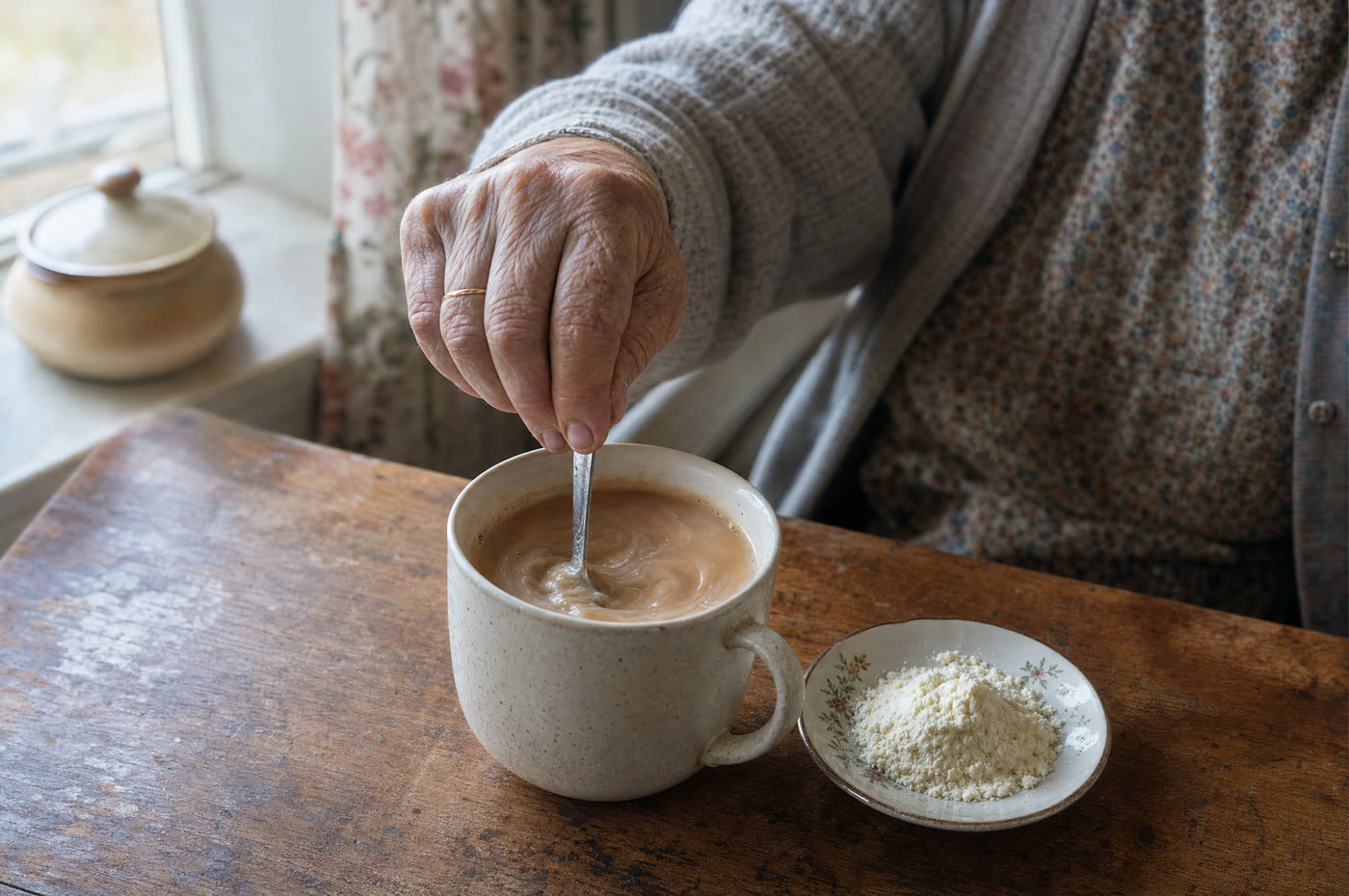
I want to introduce you to three more women, because bone health does not arrive in only one shape, and you may recognise yourself in a different one of these than you expect.
Carol, 68, still takes her prescribed tablet every morning.
Carol has been on Adcal-D3, 1,200mg daily, for six years, and has never missed a dose. She added one scoop of Goatly to her tea alongside it, on her GP's advice to keep the tablet exactly as prescribed and treat the powder as food, not medicine. Within the first ten days, a heaviness after breakfast she had quietly assumed was simply what sixty-eight felt like began to lift. By week five, her fingers were less stiff on the car door handle in the morning. Her next scan, six months in, showed the smallest drop her clinic had recorded in four years, the best result of her four years on that tablet, and the only thing she had changed was one scoop stirred into her tea.
Denise, 61, was taken off her calcium tablet by her own GP.
At her last medication review, Denise's GP looked at her food diary and decided she was getting enough calcium from her diet already. He stopped the tablet and kept her on vitamin D alone. Denise did not feel reassured. Getting enough calcium on paper had never told her whether that calcium was reaching her bone, and her last scan was still sitting in a drawer with a number on it she had not shown anyone. She started Goatly not to add more calcium to a diet that was apparently already sufficient, but to give the calcium she already ate somewhere to go. Six weeks in, she described it to me as the first thing since her diagnosis that had answered the actual question, rather than the easy one.
Susan, 59, has avoided dairy for a decade because of her stomach.
Milk and yoghurt had caused Susan bloating and stomach pain for years before a GP suggested she cut cow's dairy out altogether, which she did, gladly, along with any hope of a dairy-based calcium source. Goat milk's A2 protein is structurally different from the A1 protein in most cow's milk, and it sat fine with her from the first week: no bloating, nothing. It was the first dairy product in ten years she could stir into her tea without bracing for the aftermath. Her own bone scan had come back on the wrong side of normal the same month she started, which is, in the end, why she was in my clinic at all.
Julie, 57, was diagnosed three weeks before I met her.
Julie's sister broke her hip at sixty-two, which is why Julie booked the scan she had been putting off for two years. Hers came back at minus 1.3: osteopenia, the earliest stage at which anything can still be done before it becomes something harder to undo. Julie found this article the way you likely have, at midnight, searching for anything more useful than "it's just your age." She started Goatly the next morning, at the earliest point there is to act on a number like hers. Minus 1.3, caught now, has more roads open to it than the same number would if she waited another five years to look, and Julie is already ahead of where Frances or Carol were able to start.
Across all four of them, the pattern of what they noticed, and when, was strikingly consistent. Digestion first, inside the first two to three weeks. Morning stiffness easing some time around week four to six. By the third month, one full cycle of bone remodelling has typically completed, which is where any real change in density has to begin. The scan itself, when there is one due, generally falls somewhere between six and twelve months later. That is the pattern you can expect too: digestion easing within the first few weeks, stiffness settling not long after, and a letter that finally reads the way you have been waiting for it to read.
See what the four of them added to their morning cup →
The Five Questions Every Sensible Woman Asks First
Before you read any further, let me answer the five questions every sensible woman asks before she tries anything new, because you should not have to hunt for these answers in a comments section.
Should you stop the tablet your GP prescribed?
No. Not on the strength of this article, and not on the strength of anything I say to you. If you are taking a prescribed calcium tablet, alendronic acid, or any other bone medication, keep taking it exactly as directed. Goatly is a food, taken alongside whatever your doctor has already put you on, not instead of it. The only person who changes your prescription is your GP, and it is worth printing this page and taking it to your next appointment, the way Carol did before she added her own scoop.
Do you already get enough calcium from your diet?
Possibly. Your GP may even have told you exactly that, the way Denise's did. But enough calcium on paper and calcium that reaches your bone are two separate questions, and most food diaries only ever answer the first one. Goatly was not built to add more calcium to an already adequate diet. It was built to give the calcium already in that diet, and the modest amount in a scoop besides, a working transport system to reach your bone instead of settling elsewhere.
Is goat milk not something you feed babies, and does it not taste strange?
Neither, in practice. Adults across large parts of Europe drink goat milk daily, and have done for generations, the same way we drink cow's milk here. Goatly tastes mild, faintly creamy, closer to warm milk than to anything medicinal, and it disappears into tea, coffee or porridge in under ten seconds. If cow's dairy has ever sat heavily on you, the way it did with Susan, this is worth trying for that reason alone, since goat milk's A2 protein behaves differently in most stomachs than the A1 protein in standard cow's milk.
If this is real, why has your own GP never mentioned it?
Because your GP has roughly ten minutes with you, and a system built to reward writing a prescription, not explaining a delivery mechanism in food chemistry. Most GPs are excellent at treating a number on a scan. Nutrition science of this kind sits closer to a dietitian's training than a GP's, and the two rarely get to compare notes in the time either of them has with you. This is, increasingly, the kind of thing I hear said quietly among nurses and allied staff before it ever reaches a ten-minute appointment. That is not a conspiracy. It is how a stretched system works, and it is not your GP's fault any more than it was ever yours.
The supplement aisle has the same problem from the opposite direction. A shelf of separate bottles has a business model built on you coming back for the next one, not on you never needing to. Nobody selling you that next bottle profits on the day your bone stops needing help, so nobody on that aisle has much reason to explain the one change that would actually get you there.
[STAT-SLOT: cijfer over omvang van de UK-calcium/supplementenmarkt, of % vrouwen 50+ die los-supplement calcium slikken zonder gemeten effect op botdichtheid]
And will it work for someone like you specifically?
Here is what happens for women like you. Carol was still fully compliant on her tablet, Denise had just been taken off hers, Susan had avoided dairy for a decade, and Julie was three weeks into a diagnosis she had not yet told her family about. If your situation resembles any one of theirs, and most women's do, you are not the exception this was not built for. You are precisely who it was built for.
What This Has Already Cost You, Before You Spend A Penny On Goatly
Before I tell you what Goatly costs, I want you to add up what the last few years may already have cost you.

Adcal-D3 or Calcichew, taken faithfully for years. Free on repeat prescription for most women your age, which is exactly why it never felt like the expensive option. The real cost sat elsewhere: the GP appointments and diet reviews that came with it, a private consultation with an endocrinologist or rheumatologist when the NHS list felt too long, commonly £150 or more for a single hour. An AlgaeCal pot at close to £100, bought once, in hope, and left half-finished in a cupboard. Separate bottles of magnesium, K2, vitamin D and collagen, bought one at a time over several years, easily totalling well over £2,000 by the time you count every abandoned tub. None of that includes what four years of quietly avoiding jars, favourite jumpers with back zips, and your own grandchild have cost you, in ways no receipt records.
Against that, Goatly runs to around 70p a day on the standard ninety-day supply. Roughly what you would already spend on the teabag and splash of milk you are stirring it into.
Now the part I need to say plainly, because I would rather you heard it from me than discovered it after the fact. Goatly is not a factory product. It comes from one small, fixed herd of pasture-raised goats on one farm in the Netherlands. The farmer cannot phone up for more goats the way a supplement company phones a contract manufacturer for more capsules. Each batch is milked, dried and packed in a quantity set months in advance, and once a batch is gone, there is a genuine gap, often several weeks, before the next one is ready. This has already happened twice this year. Both times it sold through faster than the farm expected, and the women who ordered during the gap simply waited.
I am not going to hand you a countdown clock with a suspiciously specific number on it. What I will tell you is this: check stock before you finish reading this page, not after. If it shows as available, that is one small, real farm's worth of pouches, not an unlimited supply reloading behind the scenes. If Frances were my own sister, I would tell her plainly: the tablet on your shelf will still be there next week, exactly as it is now. This batch might not be.
This batch is moving quickly.
Small Dutch herd, no factory backup supply. Check availability before you order.
90-Day Money-Back Guarantee.
Ninety Days. Two Roads. Your Choice.

Try Goatly for ninety days. If nothing has changed, in your digestion, your stiffness, or how you feel getting up in the morning, send back even an empty pouch and you get every penny returned. No form to justify yourself on, no reason required. We would rather refund you than have you keep taking something that is not working for your body specifically.
From here, there are two roads, and only you walk either of them.
On the first, nothing changes tomorrow morning. You will still run the marmalade lid under the hot tap. You will still do your bra up at the front and turn it round after. You will still say "ask granddad" when Ollie wants lifting onto the counter, and you will still leave the next brown envelope on the kitchen side for a day before you can face opening it. You know this road. You have been walking it for four years already.
On the second, you add one scoop to the tea you are already making tomorrow morning, and you give your bone the one thing none of the tablets, powders or extra portions of cheese ever gave it: a way to actually get there. Within a fortnight you will know whether your own digestion has changed. Within six weeks you will know about the stiffness. The scan will tell you the rest, in its own time, and if the first weeks bring you nothing at all, this costs you nothing to have tried.
Frances chose the second road eleven months ago. She has not told me the doorframe is measured again. But her husband tells me she stood against it in March, on her own, without being asked.
Your own next letter has not been written yet. Which of those two roads you walk is still open today, and you are the one who gets to choose it.
Give your bones what they actually need.
One scoop a day. Ninety days to know. Every penny back if it does nothing for you.
90-Day Money-Back Guarantee. Check current stock.
What Other Readers Are Saying
References
- Bolland MJ et al. (2010), BMJ: calcium supplementation and cardiovascular risk (27 to 31% increase in cardiovascular events above 500mg/day supplemental calcium).
- University of Granada research (López-Aliaga I et al.): mineral bioavailability and casein phosphopeptide transport, goat milk versus isolated calcium supplements.
- Park YW & Haenlein GFW (2007): goat milk composition, A2 beta-casein.
- Royal Osteoporosis Society: position on calcium supplements and food-first guidance; Professor Tim Spector review (33 studies, 50,000+ adults over fifty).
- British Dietetic Association: mineral co-factor guidance (calcium, magnesium, phosphorus, vitamin K2).
Disclaimer: Try Goatly is a food product, not a medicine. Individual results vary. If you have diagnosed osteopenia or osteoporosis, or take any prescribed bone medication, consult your GP before changing your routine. Nothing in this article should be read as an instruction to stop or alter a prescribed treatment.
Angela H.
Three weeks in and the thing I actually noticed first was my digestion, not my bones, which nobody warned me to expect. Stirs in fine, no grit at the bottom of the cup like the last powder I tried.
Marion T.
Am I the only one who ordered the bigger pouch straight away? Once I read the bit about small batches I didn't want to risk waiting for the next one.
↳ Beverley R.
No, I did the same. Regretted only getting one pouch the first time round, took nine days to arrive when I reordered mid-gap.
Linda K.
My daughter ordered this for me after my last review appointment. I was fairly sceptical, I'll admit, but six weeks in my hands are less stiff first thing, which is the only test that matters to me.
Joyce M.
How long does delivery actually take. Want to order before my sister's birthday, her scan came back exactly like mine did four years ago.
↳ Angela H.
Mine took five days, though I've seen others mention longer when they're between batches. Worth ordering sooner rather than later I'd say.